

ADTRAN 10G COMBO OLT_1187518F1_Total Access 8-Port GPON, XGS-PON or Combo
NOKIA 7250 IXR FAMILY EQUIPMENT
TDM-to-IP Migration:
Controlling Costs and Protecting Telecom Networks
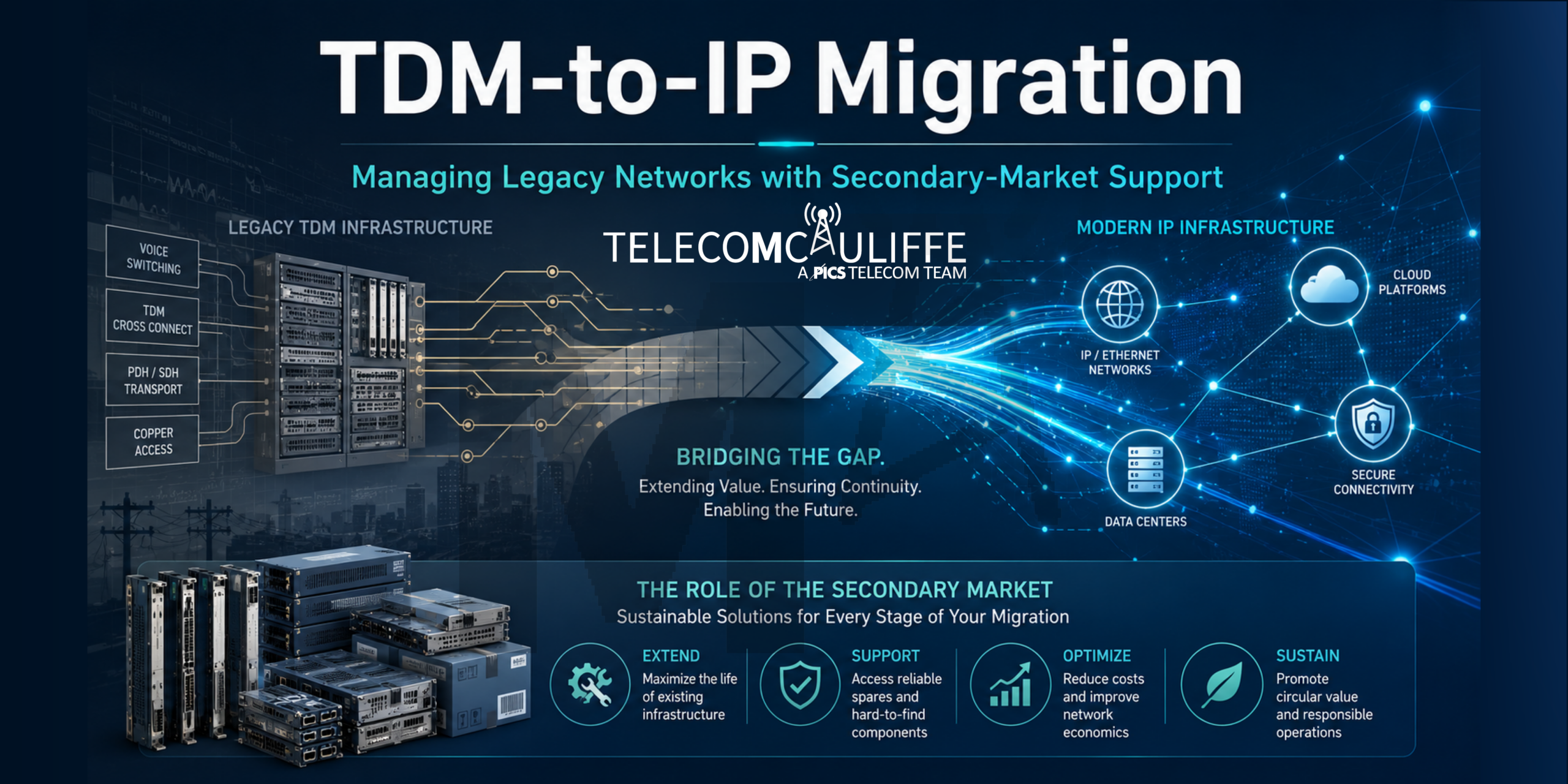
TDM-to-IP Migration Challenges: How Telecom Providers Can Control Costs and Protect Service Continuity
The telecommunications industry has been transitioning from Time Division Multiplexing, or TDM, to Internet Protocol-based networks for years. However, many regional, rural, independent, and community-focused service providers continue to operate a combination of legacy TDM and modern IP infrastructure.
For these providers, network modernization is rarely as simple as replacing an old switch with a new platform.
They must continue supporting existing customers, emergency calling, intercarrier connections, business services, T1 circuits, DS1 and DS3 transport, legacy voice applications, and other critical services while building a path toward an all-IP network.
A recent industry report on the ongoing TDM-to-IP transition highlights how difficult—and increasingly expensive—that balancing act has become.
Why Are TDM Networks Still Operating?
TDM technology may be considered legacy, but that does not mean it is no longer essential.
Many networks still depend on TDM infrastructure for:
T1, DS1 and DS3 connectivity
PRI and traditional voice services
Interoffice and intercarrier connections
DACS and digital cross-connect applications
Synchronous Optical Network (SONET) transport
911 and public-safety communications
Utility and transportation networks
Business customers with specialized circuits
Rural communities with limited alternatives
Providers cannot simply disconnect these services because newer IP infrastructure has been deployed elsewhere in the network. Existing customers and critical applications must continue operating throughout the transition. The result is often a hybrid environment in which Ethernet and IP platforms operate alongside older switching, transport, cross-connect, access, and timing equipment.
Rising TDM Costs Are Accelerating the Need for Change
The source article reports that some smaller providers have experienced significant increases in the cost of maintaining legacy TDM interconnections. In one reported example, the monthly cost of a T1 interconnection increased from approximately $600 to more than $10,000.
Whether caused by declining demand, reduced technical support, regulatory uncertainty, equipment scarcity, or changing interconnection policies, the economic pressure surrounding TDM infrastructure is becoming difficult to ignore.
At the same time, migrating too quickly can introduce equally serious risks:
- Service interruptions
- Incompatible network interfaces
- Call-routing problems
- Reduced voice quality
- Emergency-service disruptions
- Unexpected software or licensing requirements
- Extended OEM lead times
- Difficulty supporting remaining TDM customers
Federal regulators are also examining how IP-to-IP interconnection should evolve while maintaining public-safety oversight, reliable 911 connectivity, consumer protection, and fair interconnection practices.
This means providers need a practical transition strategy—not simply a deadline for removing legacy technology.
TDM-to-IP Migration Is Usually a Multi-Stage Process
A successful migration typically requires TDM and IP networks to coexist for a period of time.
Providers may need to maintain legacy equipment while implementing technologies such as:
Session border controllers, Media gateways, SIP trunking, Ethernet transport, IP routing and switching, Circuit emulation, Packet-optical transport, Timing and synchronization systems, and Network monitoring and service-assurance platforms
Circuit emulation can be particularly useful when a provider needs to carry traditional TDM services across a packet-based network. It allows certain legacy applications to remain operational while the underlying transport network moves toward Ethernet or IP. This type of phased approach can reduce migration risk, but it also creates another challenge: keeping aging equipment operational long enough to complete the transition.
The Secondary Market Can Extend the TDM Migration Window
As OEMs discontinue legacy products and reduce support, replacement hardware becomes more difficult to locate through traditional purchasing channels. The secondary telecom equipment market can help providers maintain essential services without making an immediate, high-risk network replacement.
Depending on the platform and application, secondary-market equipment may support:
- Emergency replacement requirements
- Critical network sparing
- Failed circuit cards and power components
- Legacy switch expansion
- TDM-to-IP gateway deployments
- DACS and cross-connect systems
- SONET and optical transport platforms
- DS1, DS3 and Ethernet interfaces
- Timing and synchronization equipment
- Remote switching and access systems
- Temporary capacity during migration projects
Maintaining a strategic inventory of tested spares can provide valuable protection when a legacy component fails unexpectedly. Instead of allowing one obsolete card, module, shelf, controller, power supply, or interface to force an unplanned network replacement, providers can use secondary-market equipment to preserve service while continuing modernization on a controlled schedule.
Secondary-Market Equipment Is More Than a Temporary Fix
The purpose of the secondary market is not to prevent network modernization. It is to give providers more control over how and when that modernization occurs. A reliable secondary-market strategy can help operators:
Reduce Emergency Purchasing
Unexpected failures often lead to rushed purchasing decisions. Identifying critical spares in advance can reduce downtime, expedited shipping costs, and dependence on unknown sources.
Avoid Premature Network Replacement
A provider may be ready to modernize part of its network but not every central office, customer circuit, interconnection point, or remote location. Secondary-market support can bridge that gap.
Support Phased Migration
SA controlled migration allows providers to replace equipment based on operational priorities rather than reacting to a sudden hardware failure or product discontinuation.
Protect Service Continuity
Replacement components can keep existing voice, transport, access, and interconnection services operational while new infrastructure is deployed and tested.
Lower Capital Requirements
Tested refurbished equipment can provide a cost-effective alternative for applications where purchasing a completely new platform would not be economically justified.
Legacy Equipment Planning Should Begin Before a Failure
Providers supporting TDM infrastructure should evaluate their installed base before critical components become unavailable. A useful legacy network assessment should identify:
Platforms that remain essential to customer or intercarrier services.
Components with high failure rates or limited availability.
Cards, controllers and power systems with no installed redundancy.
Equipment affected by OEM end-of-life or end-of-support notices.
Services that could be moved to IP without disrupting customers.
Applications that may require circuit emulation or gateway technology.
Hardware that could be removed, resold, reused or recycled after migration.
This assessment creates a clearer picture of which equipment should be replaced immediately, which platforms require additional spares, and which assets may still have secondary-market value.
What Happens to Equipment After the Migration?
The TDM-to-IP transition also creates significant quantities of surplus telecom equipment. Some retired assets may retain value because other providers still operate the same platforms. Other equipment may be suitable for component harvesting, refurbishment, redeployment or responsible recycling.
An organized asset-recovery program can help providers:
- Identify equipment with resale value
- Recover value from decommissioned assets
- Consolidate surplus inventory
- Remove equipment from central offices
- Reuse viable cards and components
- Reduce storage and disposal costs
- Support corporate sustainability initiatives
- Properly recycle equipment with no remaining market value
The proceeds recovered from retired infrastructure may also help offset part of the cost of the IP migration.
How TELECOMCAULIFFE – A PICS Telecom Team Can Help
TELECOMCAULIFFE – A PICS Telecom Team works with service providers, carriers, utilities, contractors and network operators supporting both legacy and next-generation telecom infrastructure.
Our role is not limited to quoting a part number.
We help customers evaluate requirements, identify compatible equipment, locate hard-to-find components, develop sparing strategies, reduce lead times and support phased network modernization projects.
Our capabilities include:
- New, used and refurbished telecom equipment
- Tested legacy TDM and transport components
- Hard-to-find and end-of-life equipment sourcing
- Cross-reference and compatibility assistance
- Critical spare and emergency replacement support
- TDM, SONET, optical, switching, access and power equipment
- Equipment removal and de-installation services
- Investment recovery and consignment programs
- Asset remarketing and responsible recycling
- Global logistics and deployment support
By supporting both sides of the transition, we can help providers keep existing services operational while preparing for a more efficient IP-based network.
Build a Controlled Path from TDM to IP
The transition from TDM to IP is continuing, but every provider’s network, customer base and operational requirements are different. Some organizations may be able to move quickly. Others must maintain TDM services for years because of rural interconnection requirements, emergency communications, specialized business circuits or limited replacement options. The most effective strategy is often a combination of modernization and lifecycle support:
Modernize where the business case is clear.
Maintain critical TDM services where necessary.
Establish a reliable inventory of legacy spares.
Use circuit emulation and gateway technologies where appropriate.
Recover value from equipment as it is retired.
Work with experienced partners who understand both legacy and IP networks.
TELECOMCAULIFFE – A PICS Telecom Team helps providers navigate this transition without forcing a one-size-fits-all solution. Whether you need a hard-to-find legacy component, support for a TDM-to-IP migration, assistance identifying compatible equipment, or a plan for recovering value from decommissioned assets, our team can help develop a practical solution around your network and timeline. Contact TELECOMCAULIFFE – A PICS Telecom Team to discuss your legacy equipment requirements, modernization projects or surplus telecom assets.
Frequently Asked Questions
TDM-to-IP migration is the process of replacing traditional circuit-switched voice and data infrastructure with packet-based Ethernet and Internet Protocol networks.
TDM equipment continues to support legacy voice services, T1 circuits, DS1 and DS3 transport, emergency communications, intercarrier connections and specialized customer applications
Certain TDM services can be transported across packet networks using circuit-emulation technology, gateways and other migration platforms. Compatibility must be evaluated for each application.
Retired equipment may be resold, refurbished, redeployed, used for spare components or responsibly recycled through an asset-recovery program.
The secondary market provides replacement equipment, critical spares and legacy components that can keep existing services operational during a phased migration.

The TELECOMCAULIFFE Difference
TELCOMCAULIFFE, A PICS Telecom Team, is a leading global distributor of telecom products and network equipment, offering an expansive selection of new, surplus, and refreshed products from over 1000 manufacturers. When you buy from the TELCOMCAULIFFE Team you’ll experience a wide range of benefits that not all OEMs or vendors offer.
- 7 Experienced Dynamic Professionals Working to Ensure the Best Pricing, Quickest Turnaround, And Highest Quality Equipment
- Standard Lifetime Warranty with Advanced Replacement
- State-of-the-Art Test Facilities and Repair Services
- 24/7 Online Customer Service
- Dedicated Marketing Professional to Sell Your Surplus Equipment
- Follow-Up Process to Ensure Customer Satisfaction