

Inventory Clean Out

Calix XG801 vs. XG1601: XGS-PON Upgrades & Surplus Equipment Value
Nokia Lightspan FX-4, FX-8 and MF-2:
Flexible Fiber Access and Smarter Equipment Sourcing
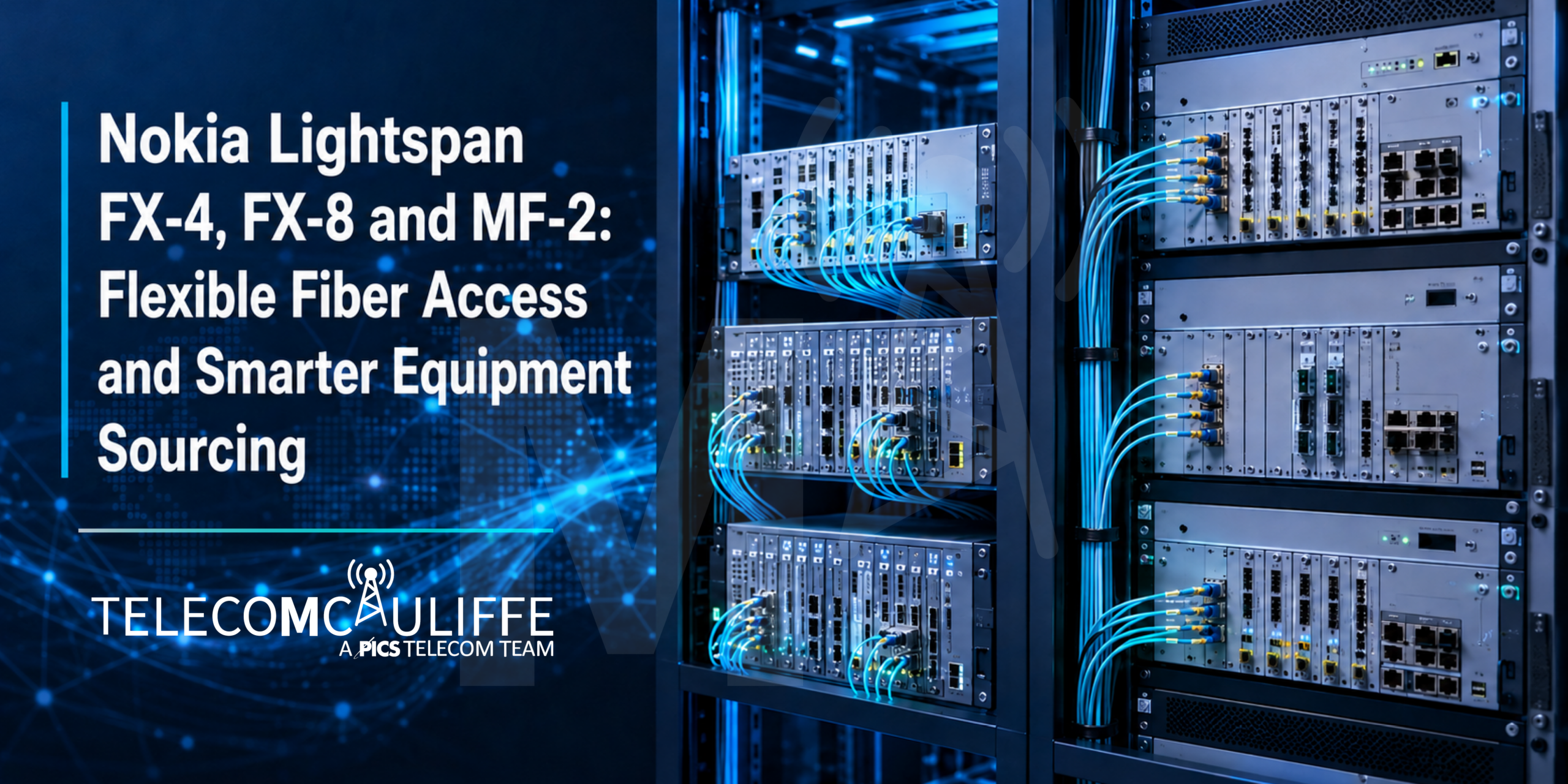
Nokia Lightspan FX-4, FX-8 and MF-2 OLT Solutions
Fiber access networks are being asked to support more subscribers, higher bandwidth and a wider range of residential, business and mobile-transport services. For network operators, this creates pressure to increase capacity without introducing unnecessary complexity, extending project timelines or replacing infrastructure prematurely.
The Nokia Lightspan portfolio gives operators multiple options for building and expanding fiber access networks. Platforms such as the Nokia Lightspan FX-4, FX-8 and MF-2 can support different deployment densities, service requirements and network-evolution strategies. However, sourcing the OLT chassis is only one part of the project.
A successful deployment requires the correct combination of chassis, line cards, controllers, power equipment, uplinks, optics and software.
That is also where experienced secondary-market sourcing can provide significant value.
What Is the Nokia Lightspan Platform?
Nokia Lightspan is a family of fiber access platforms designed to help operators deliver high-capacity broadband services while providing a migration path between multiple generations of PON technology.
According to Nokia, the Lightspan FX family can support multiple PON technologies and point-to-point services simultaneously. The FX family includes different chassis sizes—such as the FX-4 and FX-8—allowing operators to match platform size and subscriber density to the intended deployment.
This flexibility can be valuable for:
- Fiber-to-the-home deployments
- Multi-gigabit residential broadband
- Business and enterprise connectivity
- Mobile backhaul and transport
- Municipal and rural broadband
- GPON-to-XGS-PON migration projects
- Network expansions and capacity upgrades
The Lightspan family is designed to give operators a more flexible foundation for supporting current services while preparing for future capacity requirements.
Nokia Lightspan Family
The Nokia Lightspan FX-4 is well suited for smaller and mid-sized fiber-access deployments where operators require carrier-grade capabilities without the footprint of a larger chassis.
Potential applications include:
- Smaller central offices
- Remote points of presence
- Rural broadband deployments
- Network edge locations
- Targeted fiber expansions
- Lower-density subscriber areas
- Critical sparing for an installed FX-4 base
The FX-4 can provide a practical balance between capacity, physical footprint and deployment flexibility. Its modular architecture allows operators to select line cards and supporting components based on the services being delivered.
That modularity also means the exact configuration matters. Two FX-4 systems may require different components depending on their PON technology, uplink design, redundancy requirements, subscriber count and current software environment.
The Nokia Lightspan FX-8 provides additional expansion capacity for larger deployments and higher subscriber concentrations.
It may be considered for:
- Larger fiber-to-the-home deployments
- Growing regional broadband networks
- Higher-density serving areas
- Central offices requiring additional line-card capacity
- Networks supporting multiple PON technologies
- Expansion projects where an FX-4 no longer provides sufficient room
The FX-8 can give operators more flexibility to add capacity while maintaining a common platform strategy. It may also help reduce the number of individual access nodes required in higher-density environments.
Choosing between an FX-4 and FX-8 should not be based solely on the chassis size. Operators should evaluate anticipated subscriber growth, PON port requirements, uplink capacity, redundancy, power availability, rack space and future migration plans.
The Nokia Lightspan MF-2 is a compact, high-capacity access platform designed for distributed deployments and network evolution beyond traditional 10G PON applications.
Nokia describes the MF-2 as supporting Multi-PON technology, high-capacity broadband and low-latency applications such as 5G transport. It is based on the Nokia Quillion chipset and was designed to provide a compact path toward higher-speed services. Nokia Lightspan MF-2 announcement
The broader Lightspan MF family is positioned for high-capacity services including 25G PON, 50G PON and future network evolution. Nokia Lightspan MF product overview
Potential MF-2 applications include:
- Distributed fiber access
- Space-constrained facilities
- High-capacity business services
- Mobile transport applications
- Edge deployments
- Multi-gigabit network expansion
- Networks preparing for capacity beyond XGS-PON
For operators evaluating the MF-2, compatibility must be reviewed across the complete configuration rather than assuming that components from an FX platform—or even another MF deployment—are automatically interchangeable.
Many operators are continuing to support GPON while introducing XGS-PON in areas where symmetrical multi-gigabit services are required. This creates a need for platforms that can support current subscribers while providing a manageable migration path.
XGS-PON provides symmetrical 10 Gb/s capacity and has become an important technology for residential, business and mobile-transport services. Nokia also positions its Lightspan platforms as part of an evolution toward 25G PON and higher-capacity services. Nokia 25G PON overview
A migration strategy may involve:
- Maintaining existing GPON services
- Adding XGS-PON capacity in targeted markets
- Using Multi-PON cards where appropriate
- Reusing compatible chassis and infrastructure
- Adding higher-capacity uplinks
- Establishing spare coverage for critical components
- Preparing selected locations for 25G PON or future technologies
The correct strategy depends on the installed platform, software release, optical distribution network, service objectives and available capital.
How the Secondary Market Supports Lightspan Deployments
OEM channels remain important for new network construction, software support and long-term platform planning. However, the secondary telecom equipment market can provide additional sourcing flexibility when normal availability does not align with a project’s timeline or budget. Secondary-market sourcing can help operators:
1. Reduce equipment lead times
Available equipment can help keep projects moving when new OEM hardware has an extended delivery schedule.
2. Expand existing networks
Operators can locate matching chassis, cards and components for an installed Lightspan base without redesigning the entire network.
3. Build critical spare inventories
Replacement controllers, power equipment, line cards and optics can reduce the operational risk associated with a hardware failure.
4. Fill configuration gaps
A nearly complete kit may still be unusable if it is missing a specific controller, uplink, power component or mounting accessory. Secondary-market suppliers may be able to locate those individual pieces.
5. Improve capital efficiency
New-surplus and refurbished equipment may allow operators to extend the value of existing network investments while directing capital toward other expansion priorities.
6. Recover value from surplus assets
Equipment removed during migrations, consolidations or network redesigns may retain value. Resale, consignment and asset-recovery programs can generate additional ROI while keeping reusable telecom equipment in service.
Why a Complete Nokia Lightspan Configuration Matters
An available chassis does not necessarily equal a deployment-ready system. A complete Lightspan solution may require:
Properly configured chassis
Compatible PON line cards
Control and management components
Uplink cards and interfaces
AC or DC power components
Fan or cooling assemblies
Frequency band
Compatible GPON, XGS-PON or Multi-PON
Rack-mounting and cable-management
Supported software and licenses
Compatible ONTs or ONUs
Appropriate spare components
Software compatibility is particularly important. Nokia’s Lightspan operating environment is designed to provide consistent functionality across supported access nodes, but the software release, hardware revision and network-management architecture still need to align.
Secondary-Market Equipment Still Requires Due Diligence
Not every piece of available hardware is appropriate for every deployment. Buyers should evaluate more than price and quantity.
Important considerations include:
- Exact Nokia part number
- Hardware revision
- Serial-number visibility
- Equipment condition
- Testing procedures
- Repair and refurbishment history
- Software and licensing requirements
- Included accessories
- Warranty coverage
- Seller experience
- Chain of custody and equipment provenance
A knowledgeable supplier should be able to help identify what is included, what is missing and whether the proposed configuration matches the intended application.
How TELECOMCAULIFFE – A PICS Telecom Team Can Help
TELECOMCAULIFFE – A PICS Telecom Team works with telecom operators, ISPs, broadband providers, contractors and network integrators to support both current and legacy infrastructure requirements.
For Nokia Lightspan projects, we can help customers:
- Identify the correct Nokia part number and revision
- Confirm Nokia Lightspan part numbers
- Review platform and component compatibility
- Build and validate FX-4, FX-8 and MF-2 kits
- Identify missing line cards, controllers, power components and optics
- Support GPON and XGS-PON expansions
- Reduce OEM lead times
- Develop practical sparing strategies
- Locate difficult-to-source equipment
- Reduce equipment lead times
- Evaluate new-surplus and secondary-market options
- Purchase or consign surplus network equipment
We currently have brand-new Nokia Lightspan FX-4, FX-8 and MF-2 kits available, along with additional Nokia access equipment, line cards, optics and related components.
Our goal is not simply to supply an available chassis. We help customers evaluate the complete requirement so that the equipment being sourced is appropriate for the intended network configuration.
Frequently Asked Questions
The primary difference is platform size and expansion capacity. The FX-4 can suit smaller or more distributed deployments, while the FX-8 provides additional room for higher-density networks and future growth. The correct choice also depends on line-card, uplink, redundancy and power requirements.
The Lightspan portfolio supports multiple generations of PON technology. The exact capabilities depend on the chassis, installed cards, optics, software release and network configuration.
Not necessarily. The MF-2 represents a newer, compact high-capacity architecture, but whether it should replace or complement an FX platform depends on the deployment, services, management environment and migration strategy.
Yes, provided the part numbers, hardware revisions, software requirements and configuration are validated. Secondary-market equipment can be particularly valuable for expansions, critical spares, configuration gaps and projects facing OEM lead-time constraints.
Yes. TELECOMCAULIFFE – A PICS Telecom Team can evaluate surplus Nokia equipment for direct purchase, consignment or broader asset-recovery opportunities.

The TELECOMCAULIFFE Difference
TELCOMCAULIFFE, A PICS Telecom Team, is a leading global distributor of telecom products and network equipment, offering an expansive selection of new, surplus, and refreshed products from over 1000 manufacturers. When you buy from the TELCOMCAULIFFE Team you’ll experience a wide range of benefits that not all OEMs or vendors offer.
- 7 Experienced Dynamic Professionals Working to Ensure the Best Pricing, Quickest Turnaround, And Highest Quality Equipment
- Standard Lifetime Warranty with Advanced Replacement
- State-of-the-Art Test Facilities and Repair Services
- 24/7 Online Customer Service
- Dedicated Marketing Professional to Sell Your Surplus Equipment
- Follow-Up Process to Ensure Customer Satisfaction